

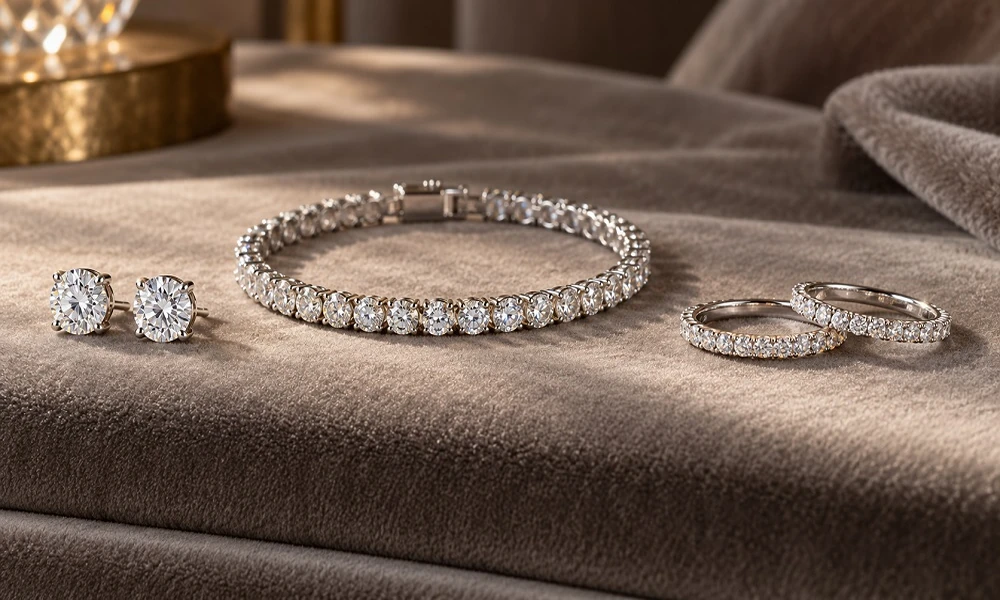
Choosing an everyday diamond piece is easier when you begin with where it will sit and how you spend your day. Earrings frame the face. A bracelet moves with the wrist. A ring stays in view whenever you reach for something. Each offers a different kind of presence.
The right starting point doesn’t have to be the largest piece or the most familiar style. Compare what each option adds to your existing wardrobe, then consider the practical details that will affect how often you wear it.
Compare The Everyday Experience.
| Style | Styling role | Detail to assess |
| Stud earrings | A compact accent near the face | Size, setting profile, and fastening |
| Tennis bracelet | A flexible line of sparkle at the wrist | Fit, articulation, and clasp |
| Tennis necklace | A visible frame around the neckline | Length, flexibility, and how it lies |
| Ring stack | A personal arrangement on the hand | Combined width, spacing, and comfort |
These are starting questions rather than universal rules. A modest tennis necklace may feel easier to wear than oversized studs. A single ring may suit your routine better than a stack. The product’s actual proportions matter more than its category name.
Milestones by Ashleigh Bergman offers diamond jewelry across several of these categories. When browsing, compare measurements and construction alongside the images. That makes it easier to judge how a design might work with what you already own.
Studs: Choose Them For The Face-Framing Detail
Studs are worth considering if you want a visible accent without adding another layer around your neck or wrist. They can sit neatly beside a shirt collar and leave space for a pendant on days when you want both.
Ask about dimensions, the setting’s height, and the fastening. If your ears are sensitive to particular materials, confirm the relevant metal details rather than relying on color. Consider your headphones, hair, and the other earrings you wear regularly.
A pair does not need to disappear to feel suitable for daytime. Use your usual clothes as the reference. If you want a stronger stud, that may be a better purchase than a smaller pair chosen only because it seems conventional.
Tennis Pieces: Compare Fit Before Sparkle
A tennis bracelet brings a repeated pattern to the wrist. Imagine its movement beside your watch, shirt cuff, and desk. Ask how the clasp works and what fit the seller recommends. Too much movement may feel distracting; too little room may feel restrictive.
A tennis necklace asks a different question: where should the line sit? Compare the stated length with a necklace you already own. Consider whether you want it visible above a collar, inside an open neckline, or worn mostly for evenings.
Photographs cannot fully explain articulation or comfort. Ask for a video or an additional view when needed. A design that looks beautiful laid flat still needs to sit in a way that works for you.
Ring Stacks: Choose Flexibility With Limits
Rings let you adjust the arrangement from day to day. One band can stand alone, while additional pieces change the balance. That flexibility is appealing if you like experimenting with your existing collection.
The tradeoff is contact. Adjacent rings may rub, shift, or crowd the finger. Compare profiles before combining them, and don’t assume two pieces are compatible just because they have similar widths. Leave room for normal movement and ask about resizing limits before purchasing.
Understand What The Description Measures.
GIA identifies color, clarity, cut, and carat weight as the four diamond quality factors. Use them as a vocabulary for questions, rather than reducing your decision to one number. Ask what information is provided for the specific piece.
Also clarify whether a stated weight refers to one stone or the combined stones. For a finished item, the overall design, proportions, and artistry still deserve attention. A specification list cannot tell you everything about how jewelry will look or feel on you.
Read the metal description with the same care. The FTC’s precious-metal buying guide helps explain common terms. Confirm materials, order conditions, and any care instructions in writing before you decide.
Choose The Piece That Answers A Real Need.
If you already wear necklaces daily, earrings might add something useful. If your wrists are usually covered, a ring could give you more enjoyment. Review the gap in your routine rather than buying a category you feel obliged to own.
Explore Milestones by Ashleigh Bergman and compare a small shortlist against your wardrobe, comfort needs, and preferred level of sparkle. Choose the piece you can picture wearing on an ordinary day.
